FoodJet
Banner

Tiger paste depositing

Tiger paste is increasingly used to create distinctive crust patterns on buns, bread, and other bakery products. FoodJet depositing solutions can apply tiger paste (material) onto your products with controlled distribution and layer thickness—depending on paste composition, product shape, and line conditions.

At a glance

FoodJet can deposit tiger paste (material) onto buns, bread loaves, and other bakery products (product) in a controlled pattern and weight. Depending on your line setup, product variability, and paste consistency, optional vision support can help target each piece individually. Recipes and dosing parameters are managed via FoodJet Designer Studio software, supporting repeatable results across batches. Talk to us to review your product range, paste type, and required pattern.
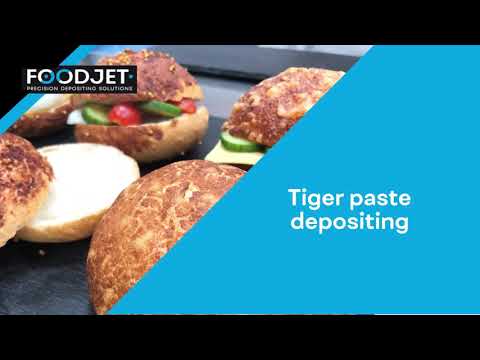
Tiger paste helps create a distinctive crunchy crust

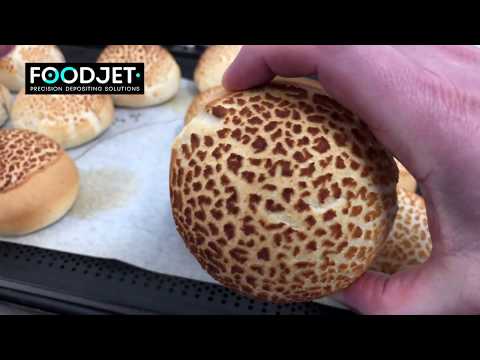
Tiger paste (also called tiger wash, Dutch crust or giraffe bread paste) is applied as a thin layer on bakery products (product) before baking. During baking the material dries and cracks, creating the recognisable “tiger” pattern. The final appearance depends on recipe, paste consistency, bake profile and how evenly the material is applied.

  • Tiger paste depositing with variations

    Exciting tiger paste variations made possible with FoodJet food depositors. More info here

  • Tiger paste depositing [with inclusions!!!]

    Not only is the FoodJet depositing system the best solution for tiger paste depositing. It can also handle tiger paste with inclusions. More info here

  • Tiger paste depositing on buns [or bread]

    It is not easy to target tiger paste precisely on buns, or bread for that matter. More info here

Ready-to-use tiger paste or mix it yourself?

There are basically two types of tiger paste. Both come in a wide range of different flavors.

  1. Ready to use tiger paste which comes in buckets that are poured into the buffer tank. There is no further processing required. The FoodJet tiger paste depositor can pump it straight out of the tank onto the products.
  2. Tiger paste mix comes in a powder form. It has to be mixed with water into a material that is lump-free before it can be processed by the depositor. 

The mix in powder form usually is cheaper. It does require equipment, however, to get it ready for production. Ready-to-use paste can be used straight away, but typically comes at a higher cost.

Tiger paste depositor

A tiger paste depositor is an industrial bakery machine that applies tiger paste (material) onto bakery products (product) in a controlled pattern and layer thickness. The right setup depends on paste type, required pattern, line speed and how products are presented on the conveyor.

Traditional tiger paste application

Depositing tiger paste consistently can be challenging with common application methods. Applying the paste manually significantly reduces production speed. And using rollers does not meet modern production requirements for accuracy and positioning. FoodJet depositing solutions can help apply tiger paste in a repeatable pattern and layer thickness, depending on product variation and line conditions.

How to apply tiger paste industrially?

Industrial application typically involves preparing the paste, loading it into a buffer/hopper and applying it via a nozzle array while products move on a conveyor. FoodJet uses an array of small nozzles; depending on product size and the required pattern, nozzles can be activated selectively. This supports controlled deposition on varied product shapes, depending on setup and product presentation.

How does it work?

Below is a typical tiger paste depositing workflow. The exact configuration depends on your product range, material properties and line setup.

Step 1
The operator selects the required recipe in FoodJet Designer Studio.

Step 2
Tiger paste (material) is prepared and transferred into a buffer tank.

Step 3
The buffer tank supplies a pump to maintain stable flow to the dosing unit.

Step 4
A nozzle array applies the material onto the products (product) on the conveyor.

Step 5
Optionally, a camera system can support product detection and targeting, depending on product variation and presentation on the belt.

Step 6
Each product receives a defined amount of material at a set position and target layer thickness, depending on setup and line conditions.

Other interesting applications

FoodJet depositing solutions can be configured to match your production process and the material you want to deposit. Depending on your requirements, we support a range of applications and materials. See related applications below.

Tigerpaste on bread

Repeatable patterns and stable deposition for uniform product appearance.

Butter on sandwiches

Even butter layers for a smooth texture and great taste

Savoury bakery depositing solutions

Always consistent for better taste

Discuss your tiger paste application

Share your product range, paste type and required pattern—then we’ll advise a suitable configuration for your line.