
Mini pizza lines often deal with product spacing variation and small changes in base position on the conveyor. FoodJet can deposit sauce (material) onto mini pizza bases (product) in controlled patterns, using vision-guided targeting depending on product presentation and line conditions. This article shows a typical setup and what to consider for high-output mini pizza topping.
Reduced reliance on mechanical alignment, depending on setup. Consistent coverage targets, depending on material and line conditions. Less overspill and waste, depending on configuration.
- Detects pizza position automatically using vision guidance, depending on product presentation and belt stability.
- Deposits sauce along a defined path and within a defined coverage target, depending on recipe settings and configuration.
- Helps reduce overspill, cleaning, and rejects, depending on line conditions and material behaviour.
Misalignment
- Problem: pizzas are not always perfectly positioned
- Impact: alignment modules, downtime
- Solution: vision-guided depositing — reduced reliance on alignment, depending on setup
Inconsistent coverage
- Impact: quality variation, spec deviations
- Solution: repeatable dosing targets per pizza, depending on material and configuration
Mess & overspill
- Impact: cleaning, hygiene risk
- Solution: targeted deposit on the product
Waste & rejects
- Impact: rework, scrap
- Solution: improved targeting and fewer rejects, depending on setup and line conditions
Capacity ceiling
- Impact: the line can’t hit the target output
- Solution: high-capacity depositing (up to… under conditions)
How it works
- The operator loads the recipe
- Camera detects position/shape/size
- The system calculates the deposit pattern
- Depositor applies sauce accurately at line speed
- If necessary, the operator makes real-time adjustments that take effect immediately
Key specs & line requirements
- Capacity: up to 80,000 products/hour (example: 600 mm conveyor, 100mm product size; depending on dose volume, line speed, and configuration)
- Conveyor width: configurable — from standard widths up to >3000 mm
- Product size: from approx. 50 mm and up (depending on product and required pattern)
- Alignment: not required
- Sauce type: approx. 3 - 12 Bostwick (30 sec)
- Changeover: instant changeover through software recipe. Adjustments take effect immediately
- Cleaning (typical): between runs 15–30 min; end-of-day 30–45 min (depends on product, hygiene standard and cleaning method)
Accuracy, edge control, and waste reduction
Mini pizzas vary in position on the conveyor. With vision-guided targeting, FoodJet deposits sauce where it should be—on the product, not next to it.
What you gain
- Consistent coverage per pizza: the same deposit pattern and amount, every cycle
- Better edge control: less sauce near the product edge when required, improving appearance and reducing spillage
- Less waste & fewer rejects: fewer mis-doses, less rework, and less cleaning of the belt and equipment
Results depend on sauce properties, deposit volume, line speed and configuration.
Changeover and cleaning
Production flexibility only works when changeovers and cleaning are predictable. FoodJet is designed to enable rapid parameter changes via software recipes and practical cleaning routines for day-to-day operation.
Recipe-based changeover
Change deposit volume and pattern through saved recipes. No mechanical changeover steps are required.
Cleaning routines (typical)
- Between runs: 15–30 minutes
- End-of-day: 30–45 minutes
Cleaning time depends on sauce viscosity/particulates, temperature, deposit volume, and your hygiene standard.
Less mess helps uptime
Because material depositing is accurately targeted on the product, there is typically less overspill onto the belt and surrounding equipment—reducing cleaning frequency and improving overall uptime.
Get a capacity estimate for your mini pizza line
Send us your product size, target dose and line speed. We’ll recommend a configuration and an expected throughput for your layout.
What you’ll receive
- Suggested configuration (lanes/conveyor width / depositing setup)
- Throughput estimate and key assumptions
- Next steps for a demo or test
Check out videos
Check all videos-
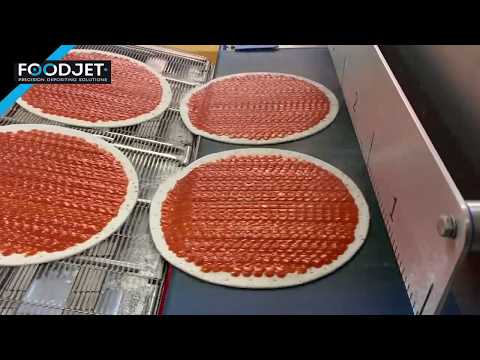
Pizza sauce depositor MDL [maximum flexibility]
Accurately depositing pizza sauce before the oven on a 800mm wide conveyor. More info here